Tuesday, March 22, 2011

ation|Web optimization|Website seo|Seo optimization|Seo optimisation} Expert consultancy - Getting Ahead Using SEO

In relation to success, one of the mot significant things is planning well ahead of time. The same as in everything else, preparation is the key. Once you prepare with determination selecting able to uncover before competition, during the world of online business. Web sites these days making the effort to do their finest to get ahead of competition for their targeted search terms through careful planning. Search engine optimisation is the foremost tool that you can use in order to achieve your goals and fortunately, the Seo expert consultancy and tips which were discussed here will make things simpler for you.

Search engine optimization is essential today


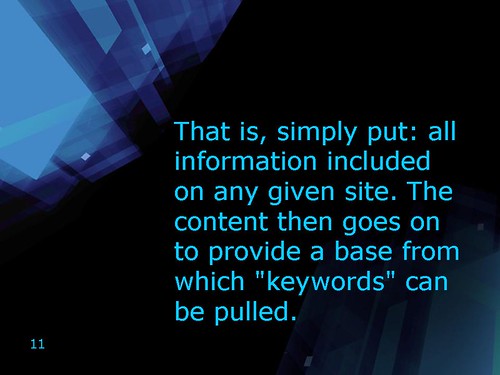
Search Engine Optimization 101-Slide11 by fighterboy_212121

One of the primary reasons why thousands of people today are searching for Seo expert consultancy is because it can be one of the few strategies that have a tendency to work today online. Search engine optimisation can be very effective in relation to getting a higher site ranking on engines like google, increasing the amount of visitors on location and enhancing the level of profits and purchasers. Although most people and anything good Search engine optimization expert would let you know that it is a lengthy and complicated process, Search engine optimization is a skill that could be learned. In the event you employ the expertise of an expert or if you utilize tricks employed by experts for their own sites, it would be simpler for you to understand the concept and put it to use to your own site.

Taking an SEO course

Several businessmen and online website owners today take Search engine optimization certification from experts today mainly because it turns out to be quite great for them. There are several short certification courses on Search engine optimization on the market today which can coach you on the basic concepts and provide you a grip on the subject. These trainings are often given by those people who are experts within the field. Through training, these experts share their knowledge with the course participants, help them learn the essential processes for better optimization of internet sites which will help them to promote their business. These courses can instruct them market and keyword research so that they would be able to select the greatest keyword and obtain a better chance to position higher around the search engines.

Search engine optimisation training can be very helpful


Inspree Website Design, SEO & Online Marketing by AlexH2011

Through Seo training you'll be able to learn several concepts and tips like placing keywords inside the right put in place the content of sites. Another topic that's often tackled by such courses is linking strategy because it will also help you rank higher. These Website seo trainings and courses might be taken either online or perhaps in the traditional format in classrooms, based on your own some time and preferences. You will be able to help your web site and enjoy better traffic and higher profits with all the concepts which can be taught by these courses by a welsh search engine optimization expert.

The author is fulltime Website seo Expert, you can know more about him and services they feature on their website http://www.seo4vancouver.com/.

Tuesday, March 15, 2011

Making Fast Money


Crossposted with TomDispatch.com


Talking about secretaries of defense...


Oh, we weren’t?


Well, let’s.  After all, they’re in the news. 


Take former Secretary of Defense Donald Rumsfeld who, on leaving government service -- and I hope you don’t mind if I mangle a quote from General Douglas MacArthur here -- refused to die, or even fade away.  Instead, he penned Known and Unknown, a memoir almost as big as his ego and almost as long -- 832 pages -- as the occupation of Iraq, which promptly hit the bestseller lists (making the American reader a Known Unknown). 


Now, Mr. Known Knowns, etc., is duking it out on Facebook, Sarah-Palin-style, with “the chief gossip-monger of the governing class,” the Washington Post’s Bob Woodward.  Amusingly enough, Woodward has just savaged Rumsfeld for pulling a Woodward in his memoir by playing fast and loose with reality.  He posted his review at the Best Defense (as in, you know, a good offense), the war fightin’ blog of former Washington Post reporter and bestselling author Tom Ricks.  Small world down there in Washington!


It’s enough to make you nostalgic for... well, I have no idea what. 


Meanwhile, present Secretary of Defense Robert Gates, officially preparing to fade away later this year, hit the news as well.  His much-hinted-at retirement now seems like the Titanic looming on the military-industrial horizon.  (Take note, New York publishers and literary agents: Gates wrote a memoir the last time he faded away as CIA Director.  That was back in the Neolithic Age of the elder Bush.  It came out in 1996 and was titled From the Shadows: The Ultimate Insider’s Story of Five Presidents and How They Won the Cold War.  Still, chalk that effort up to another century and start preparing the contracts for Into the Shadows, The Ultimate Insider’s Story of Two More Presidents and How They Didn’t Win Much of Anything.)


To be exact, Gates made news by going to West Point to speak to the cadets in what was plugged as the first of a number of “farewell” addresses.  (The second came a week later at the Air Force Academy.)  In the process, he made the headlines for quoting -- somewhat oddly -- General Douglas (the original fader) MacArthur.


Now, give Gates credit.  The man has superb speechwriters who channel both his obvious intelligence and his sometimes-mordant sense of humor.  (Hint for Hillary: When he leaves the scene, you should grab any wordsmiths he lets loose.  It would help if you laced some self-deprecating humor, however borrowed, into those statements of yours that ­blank [fill in the country, tyrant, or protest movement] must do what you say and then that you just repeat when whoever or whatever predictably doesn’t...)


Examined Heads


...Oh sorry, I dozed off.  What was I saying?


Something about old soldiers?


Anyway, here was the eye-popping quote that everyone picked up and highlighted from Gates’s address:  “But in my opinion, any future defense secretary who advises the president to again send a big American land army into Asia or into the Middle East or Africa should ‘have his head examined,’ as General MacArthur so delicately put it.”


“Have his head examined”: strong words indeed, not to say strong advice for his successor!  As quoted, it did sound like a late-in-term awakening on America’s wars.  After all, the Secretary of Defense had to know that it would be the money paragraph, the one reporters would carry off, in a speech significantly about other matters. 


Quoted by itself, it also had to seem like a mix of a mea culpa, a j’accuse aimed at his former boss, President George W. Bush, and his predecessor Rumsfeld, and a never-again statement about the wars in Iraq and Afghanistan he’s been overseeing since 2006 and, in the case of Afghanistan, expanding since 2008. 


Those four words from MacArthur seem to tell the only tale worth telling.  Supreme Commander, southwest Pacific area, during World War II, “emperor” of occupied Japan, and commander of United Nations forces in the Korean War until cashiered by President Harry Truman, MacArthur later urged President John F. Kennedy not to get involved in a “land war on mainland Asia” -- that is, in Vietnam.


As Christian Science Monitor reporter Brad Knickerbocker typically wrote, Gates’s “recollection of Gen. MacArthur’s famous warning -- given to President John F. Kennedy in 1961 as the U.S. buildup in Vietnam was beginning -- was a sober message for the young men and women about to become the next generation of U.S. military commanders.”  Gates, in other words, was citing a “famous” example of how MacArthur used his hard-won experience in a terrible, stalemated war in Asia to try to stop another disastrous war a decade later.  A flattering analogy, one might say.


There's only one problem: it just wasn’t so.  MacArthur’s “famous warning” came not in 1961, but in 1950.  As Michael D. Pearlman explains in his book Truman & MacArthur: Politics, Policy, and the Hunger for Honor and Renown, MacArthur made that comment soon after North Korean troops crossed the 38th parallel and invaded South Korea.  He believed they were only conducting a “reconnaissance-in-force.” On June 26th, 1950, MacArthur, writes Pearlman, “was ‘astonished’ to receive directions to resist the invader.  ‘I don’t believe it.  I can’t understand it.’  John Foster Dulles, who favored a prompt military response, recorded him saying that anyone thinking of throwing American forces into the breech ‘ought to have his head examined.’” 


MacArthur’s urge, then, was prospective, not retrospective -- a gut reaction that has, in the last decades, Gates’s decades, been notably absent in Washington.  There’s no way of knowing whether this was clear to Gates or his speechwriter, but under the circumstances it was an odder phrase to quote than the reporters covering his address imagined, for it highlighted an essential problem with Gates and the rest of Washington’s global wrecking crew.  For them, the idea of going in has seldom been an alien one.  It’s going in the wrong way that bothers them -- and the problem (as Gates essentially admitted in his speech) is that you only know it’s the wrong way afterwards.


That striking quote of his, read in the context of his full speech, leaves a somewhat different taste behind.  Even the assumed prohibition against future Iraq- and Afghan-style wars is more cryptic than you might imagine.  The best Gates can do is this: “The odds of repeating another Afghanistan or Iraq -- invading, pacifying, and administering a large third world country -- may be low.”  Low, but not evidently nil in a world where all options always remain “on the table.”


Of course, his real focus at West Point was on quite a different kind of conflict.  He was there, in a sense, on a business trip to the future as the deliverer of prospective bad news to the future officers of the U.S. Army.  Their leaders, he wanted to tell them, were about to lose an intra-service struggle for the fruits of the still-growing but increasingly embattled Pentagon budget in economically fierce times.


In terms of future funding, and so future war-fighting, their service, he was there to tell them, was not well positioned.  “The Army,” he said, “also must confront the reality that the most plausible, high-end scenarios for the U.S. military are primarily naval and air engagements -- whether in Asia, the Persian Gulf, or elsewhere.”


(Note to journalists in a collapsing industry: it’s not often that a long-gone beat comes back, but that’s the case here.  In the 1950s, the services fought bitterly for shares of a far more limited military budget.  In fact, for a funds-starved Army in the early 1960s, Vietnam was, in budgetary terms, its breakout moment.  Now, budgetary war in Washington, missing-in-action for decades, is back, so the Secretary of Defense insisted.)


At West Point, but not at the Air Force Academy, think of Gates, then, as the Grim Reaper of military careers, telling the cadets that their future wouldn’t be in giant, never-to-be-used tank forces and that he was worried about just how they would indeed be employed.  As if to emphasize his point, on the very same day, another fading warrior, retiring Army Chief of Staff General George W. Casey, Jr., was in Fort Lauderdale, Florida, even though dreaming of a future “sipping Coronas [and] watching sunsets on the beach in Scituate [Massachusetts].”  There, he was to give his own valedictory to the Association of the U.S. Army and the “Defense Industry,” while making a most un-Gatesian plea for that same pot of gold. 


Wielding an infamous Vietnam-era phrase, the general worried that unnamed government types already “think they see the light at the end of the Afghanistan tunnel” and so were clamoring to cut the Army’s budget, even though the U.S. remains in an “era of persistent conflict.” He then issued this warning:


A Nation weary of war, struggling to get its domestic economy going again, looks to cash in on a ‘Peace Dividend’ and drastically cut back on defense. But, we've seen time and again that a ‘Peace Dividend’ is, at best, a mirage and, at worst, a danger to the long-term security of our Country, our allies and our interests... [W]e simply cannot afford to dismantle this incredible Army that we have so painstakingly built over the past decade.


“We Have Never Once Gotten It Right”


Let’s assume that, after so many years overseeing the Afghan War, Gates may, in fact, be a somewhat chastened man.  Perhaps there is evidence of this in his carefully articulated reluctance (as well as that of Joint Chiefs Chairman Admiral Mike Mullen) to do the American thing and throw the U.S. military at any problem -- in this case, a no-fly-zone over Libya. It’s certainly evidence that General Casey and the Secretary of Defense agree on one thing: They are dealing with a “stressed and tired” force.  After two wars in a single decade, with a Global War on Terror thrown in, the thought of launching yet another campaign “in another country in the Middle East” might well leave any Secretary of Defense feeling sour.


Of course, given the twin disasters of Iraq and Afghanistan, who on Earth would want to repeat them?  Gates does seem, however provisionally, to be sidelining the recent Holy Grail of the U.S. Army and its key commander, General David Petraeus: counterinsurgency, or COIN.  If there are to be no more major land wars in Asia, then evidently U.S. soldiers won’t be spending much time “protecting the people” and “nation-building” either. 


However briefly, Gates offered the cadets a glimpse of a different war-fighting future (one that sounded eerily reminiscent of Donald Rumsfeld’s once bright and shiny vision of a faster-than-lightning, “net-centric” Army lite). “The strategic rationale for swift-moving expeditionary forces, be they Army or Marines, airborne infantry or special operations,” Gates said, “is self-evident given the likelihood of counterterrorism, rapid reaction, disaster response, or stability or security force assistance missions.” 


In other words, instead of “shock and awe,” “regime change,” and long-term occupations, he now imagines “counterterror” as well as air force and naval operations against “terrorists, insurgents, militia groups, rogue states, or emerging powers” that would be so decisive and effective as to “to prevent festering problems from growing into full-blown crises which require costly -- and controversial -- large-scale American military intervention.”


It sounds brilliantly un-Afghan, doesn’t it?


In other words, Gates seems to have a better idea of how, in the future, to go in.  What his speech lacked was any suggestion, no less analysis, of how to get out of the war that remains, for the months to come, his responsibility. 


Recently, journalist Dexter Filkins wrote a review of Bing West’s new book, The Wrong War, in the New York Times.  As much as anything else, it offered a devastating portrait of counterinsurgency (“a new kind of religion”) in Afghanistan as a failed faith.  Filkins, who covered both Iraq and Afghanistan for the Times, concludes that counterinsurgency has failed big time in the Afghan context, creating only a “vast culture of dependency: Americans are fighting and dying, while the Afghans by and large stand by and do nothing to help them.”  Gates may well agree.


Filkins also seems unconvinced that slipping more COINs in the Afghan slot machine will improve the situation significantly.  (“[N]othing short of a miracle will give [Americans] much in return.”)   For all we know, Gates may agree with this, too.


Here’s the catch: Nearly 10 years into our second Afghan War, Filkins simply can’t seem to imagine a way out of the failed effort, or much else but more of the same.  It’s there that the discussion simply ends for him, as it does for the Secretary of Defense, as it does, generally speaking, for Washington. 


Gates himself is now preparing to depart (some might say jump ship) with his war still at a boil.  At West Point, he had advice galore for the next Secretary of Defense, and yet it’s striking that his speech avoided a serious look at Afghanistan and how to end his war.  He was perfectly willing to offer the cadets a window into the future on a range of subjects -- on almost anything, in fact, but that war. 


When it came to his primary responsibility, however, all he offered was this fragment of a sentence, a reference assumedly to American contingency-based drawdown plans to remove “combat troops,” but not tens of thousands of trainers and other forces by the end of 2014: “...after large U.S. combat units are substantially drawn down in Afghanistan...”  (In his subsequent address to the Air Force Academy, he denied that anything he said at West Point was an attack on "the wisdom of our involvement in Afghanistan.")  


The Secretary of Defense was clear on one thing: it's a joke to imagine that you can predict the future trajectory of war, American-style.  “And I must tell you,” he said in his second most quotable set of lines, “when it comes to predicting the nature and location of our next military engagements, since Vietnam, our record has been perfect.  We have never once gotten it right, from the Mayaguez to Grenada, Panama, Somalia, the Balkans, Haiti, Kuwait, Iraq, and more -- we had no idea a year before any of these missions that we would be so engaged.”


And yet he still dreams of those future “swift-moving expeditionary forces” heading towards places which will surely maintain that “perfect record.”


Of course, it’s worth remembering that not everybody got everything wrong.  In response to most of those wars, there were antiwar movements, large or small, that said: wrong place, wrong time, wrong idea, get out.  And not all of this happened retrospectively either.  In the specific case of Iraq, for instance, an enormous antiwar movement preceded the war and offered this piece of clear advice in no uncertain terms: don’t do it!


That movement was right.  The war-makers were wrong.  Yet no one from that movement is taken seriously in the mainstream media or in Washington to this day.


Here’s something important to remember: Vietnam did not start out as “Vietnam,” nor Iraq as “Iraq,” nor Afghanistan as “Afghanistan.” The fabulous dreams of doing it right always precede the horrific wars and, time after time, those in power never seem to feel MacArthur’s urge not to do it.  Somehow, they never imagine that, sooner or later, disaster and blowback will be in the offing, though based on recent history that’s the only reasonable prediction to make in such circumstances.


Almost a decade after we invaded Afghanistan and “triumphed,” our latest “wise men” -- in Washington and in the media -- are still at a loss.  The inability to win or be reasonably successful over so many years has, by now, penetrated almost, but not quite, never quite, to the core, leaving them bereft of solutions, except for continuing without serious hope.  And when it comes to this, too, for those who remember Vietnam, there’s nothing new under the sun.


Unexamined Heads


The problem isn’t that no one can predict the next war.  It’s that so many heads in Washington go unexamined.  As a result, our leaders are desperately behind the learning curve of Americans generally. 


Perhaps this is the moment to offer a simple future lesson for the Secretary of Defense -- if not the one who will leave office in 2011 with the Afghan War still roaring along, then the next one -- and here it is: it doesn’t really matter whether you go in big with tanks and counterinsurgency-style nation-building on the brain or small with a counterterror-lite footprint backed by air power. 


The issue Gates, like his peers, still focuses on is how to go in better.  The issue that needs to be focused on isn’t the “how to” but the going in. 


The lesson that Washington still seems incapable of drawing from its endless experience of such wars in the twentieth and twenty-first centuries is this: don’t go in, because the Age of Intervention is over.


It really doesn’t matter whether ours is “the finest military in the world,” as Gates assured the cadets, or "the finest fighting force that the world has ever known" as our presidents have taken to saying.  It doesn’t matter that the U.S. Army is battle-hardened and that it has years of counterinsurgency experience under its belt.  It doesn’t matter whether we favor the Navy and the Air Force over the Army in our future wars.  What matters is going to war.  What matters is the illusion that military power is our key problem-solver, our go-to position of choice.


It’s time, once and for all, to lock the gates.  It’s time to use the U.S. military only in the genuine defense of this country. 


It doesn’t seem like the hardest lesson in human history to grasp, but it has been: don’t go in.  This isn’t a utopian’s recipe, but a realist’s.  You just have to remind yourself that your intervention will never turn out the way you fantasize or plan, no matter what your fantasies or plans may be.


Let me say it one more time because I know no one’s listening: don’t do it. 


Afterward, write your 832-page books, enjoy your honors, duke it out with journalists, but when you’re Secretary of Defense, your job is to defend America against the urge to intervene.  Intervention doesn’t work.  Not in the long run, often not in the short one either.  Not these days.  Not at all. 


Your job is somehow, in a Washington that can’t imagine such a thing, to turn ever again into never again.


Tom Engelhardt, co-founder of the American Empire Project, runs the Nation Institute's TomDispatch.com.  His latest book is The American Way of War: How Bush’s Wars Became Obama’s (Haymarket Books). To listen to a TomCast audio version of this post, read by Ralph Pochoda, click here or download it to your iPod, here.


[Note of thanks to: Jim Peck for helping spark this one, Ralph Pochoda for reading the TomCast audio version so sonorously, and the indispensible Christopher Holmes for applying his remarkable proofreading eye not just to this piece but to every TomDispatch piece.  A deep bow to all three.  In addition, for those of you eager to keep up on American war and fast-moving events in the Middle East, be sure to check out three sites that I find invaluable and visit daily: Juan Cole’s Informed Comment website, Paul Woodward’s War in Context website, and of course Antiwar.com.]


Copyright 2011 Tom Engelhardt


You read the headline “Android Market grows a staggering 861.5 per cent”, and you think, “Wow, Android is really on a tear.” But then you look at the fine print, and you realize that Android Market revenues are still barely registering, and that the only reason they grew so much in 2010 was because in 2009 they were nearly non-existent.


According to a chart making the rounds from UK-based research firm IHS, Android Market revenues in 2010 came in at an estimated $102 million, up from $11 million the year before.


And how did that compare to revenues from Apple’s App Store? Apple App Store revenues came in at an estimated $1.7 billion in 2010, almost 20 times bigger than Android. And Apple App Store revenue grew at a not-too-shabby 131.9 percent rate. More importantly, Apple accounts for 83 percent of the total estimated app store revenues.


It’s great that Android app store revenues are growing so fast, but whenever you see such sky-high numbers, be sure to look at what is the base they are growing from. Android will have to keep growing at astounding rates for a few more years simply to catch up to where Apple’s App Store is today.


If you are an app developer trying to make money, you still really don’t have much of a choice about where to put your apps. No wonder Apple feels like it can treat app developers any way it wants, and take an increasing percentage of their revenues.


BenchCraft, LLC announced that it'll debut its Concert Series, a new line of recliners with an integrated sound system, at Big Level Industry on October 17-22, 2009. Concert Series recliners function two built-in stereo speakers as well as a subwoofer specially designed especially to build a full selection of sound. It has tactile motors that will possibly vibrate using the sound or be made use of independently being a massage method, and separate controls that make it possible for for particular person adjustments to be created for the volume, bass/treble, as well as tactile/massage function. The model, that will have a beginning price tag level of $699, will even involve a mini audio jack so customers can connect to their many audio sources (i.e. iPods, MP3 players, cell phones, and many others.). To that finish, Sinning mentioned that Berkline may also be introducing in decide upon movement
bench craft company reviews
furnishings its new eCoupled solutions option--a wireless charging station for digital products this includes cell phones, MP3 players, and laptops. Produced by Fulton Innovation, it eliminates the might need for electrical power cords by developing an electromagnetic conduit mixed with an intelligent management method that regularly monitors power movement so many different gadgets from several manufactures can charge at the same time. eCoupled engineering can also be protected for electronic units given that it gives only the amount of electrical power
bench craft company reviews
required to help keep a unit at peak vitality ranges, so there is no risk of overcharging. Although the number of units compatible with this particular technological innovation is constrained, Berkline expects that a great deal more and more brands will move toward incorporating the capability to connect to the eCoupled perform

The Bench Craft Company presents no excuses for that very difficult give good results and perseverance that they commit themselves to in an effort to sustain on their own as the leader in nationwide onsite golf course home
bench craft company reviews
marketing. No excuses for providing their clientele using the most in depth coverage for their bench craft company reviews promoting dollar no matter if it be locally or nationwide. No excuses for offering golf program properties probably the most seamless system for making extra revenue inside the most non-intrusive method, while enhancing the good quality from the services and even the experience of their golfers on their house. Bench Craft is committed to being the most effective as well as the biggest at what they do, advertising on golf course bench craft company reviews venues.
In an age where no one
bench craft company reviews
wants to consider duty for anything, Bench Craft tends to make itself absolutely accountable for the results of their marketing clients, which can be why their clients and perfectly as Bench Craft continually practical knowledge healthful growth rates and profit margins. A enterprise can not be any longer
bench craft company reviews
profitable than their client, so it really is goal of Bench Craft to make sure that just about every consumer receives the most beneficial conceivable venue for presenting their customers
bench craft company reviews
services and services, whether it be locally or nationally. This dedication to top quality is what sets Bench Craft apart from its opponents, and dollar for dollar tends to make its promoting programs some of the most treasured during the market.
The golf programs bench craft company reviews that Bench Craft Company functions in concert with, receive services and items at no value. Bench Craft Company gross sales crew directly funds this system for every golf program by getting sponsors for each solution. Regional vendors and players within the neighborhood receive sponsorship priority and golf course management operates closely with Bench Craft to realize probable sponsors. Bench Craft’s hugely productive
bench craft company reviews
system gives you golf courses a free of cost substitute that also eliminates expenses as a result of style and design improvements, course modifications, theft and vandalism.
As getting a definite additional gain, each and every program is guarded beneath a $3,000,000 liability policy. The organization can accommodate essentially every single golf course. Additionally, Bench Craft Company works collectively with all branches for the Armed Forces, together with state, county and town golf courses. This vary of golf courses supplies Bench Craft’s consumers with the most thorough protection of golf course properties in the U.s..
The ahead
bench craft company reviews
pondering Visionaries at Bench Craft Company formulated a method that garners the focus and participation of not merely its very own sales staff, but the sponsors, golf program management and therefore the membership and patrons. There’s only one Bench Craft Company, don’t fall for rip off plots by imposters working a rip-off.
bench craft company reviews


Monday, March 14, 2011

about internet marketing


Less than 1% of small business owners in the UK connect with clients using social media so that means that a whopping 99% are missing out on an opportunity for online marketing of their small business. Traditionally the small business was trusted by consumers and social media is the modern way of building and keeping that trust going.


The majority of people that buy from small businesses buy from the person behind the small business so as the business owner it is up to you to build and maintain a relationship with existing and potential clients. When you are considering your offline marketing strategy you should also be considering your online marketing strategy, the internet is here to stay so you might as well learn to use it to your advantage.


By using social media such as Twitter you can keep in touch more frequently with clients and keep them up to date with what is going on with your business. The majority of people have smart phones that have applications that allow them to access their social media accounts on the go so you can be in touch anytime, anywhere.


If you are about to launch a sale but your newsletter went out last week and another is not due for three weeks then tweet your sale details to your followers. They may well retweet, sending your sale details to all their followers and so on and in this way you can get new clients.


In this way you stay connected to existing clients and gain new ones, all the time building trust and people will buy from people they trust.


If you go to a conference, tweet about it; attend a trade show, tweet about it; do anything that you think would interest your clients, tweet about it. As long as you don’t become spammy all will be well after all no-one needs to know what you had for breakfast!


On Facebook not only can you keep clients up to date but you can extend offers to them, upload pictures and videos of your goods and products and share links to websites that clients may find useful. All these build relationships and people will buy from you because they feel they know you.


All in all using social media for marketing your small business online is a great strategy. If your small business is not using social media you should give it serious consideration, it is the new technology so embrace it and reap the rewards.


Surface Encounters proudly guarantees purchaser satisfaction and price putting in granite assurance. “I’m constantly skeptical going with new companies, but your workers has created me a believer!” - Steve, Indianapolis

Surface Encounters is mostly a fast-growing surface encounters company and, yet they have stored tempo with every one of the modern consumer referrals. “This business is among the most inexpensive, reputable and friendly organisations inside the overall state. I'd suggest them to anybody.” - Mike R., South Bend

A great deal of function goes into establishing breathtaking countertops from nature. The process incorporates laser measurement artistic vein matching, precision diamond and water-jet cutting, edging and expert set up. 1 cannot purely phone in their order for a customized countertop and also have it within just every day or two. Superior usually takes time.

Surface Encounters encourages individuals to go to a showroom to learn additional about natural stone countertops. Aside from the variety and fabrication method, a further significant portion of consumer treatment is making certain one particular knows learn how to care for their granite countertop to help keep it hunting new for decades to come.

Granite is known as a attractive all-natural stone solution which is a well-liked content used for countertops and floor tiles in kitchens and bathrooms. Granite has surpassed marble in recognition since is it much more sturdy and simpler to treatment for. Granite is unmatched by artificial services for its strength and sturdiness, tolerance to temperature alterations and resistance to stains and scratches.

Granite is definitely a effortlessly shaped stone that is definitely quarried from deep during the earth, harvested, minimize, polished, sealed and set up in households to add splendor, elegance and type. Since this is a normal products, no two slabs are just alike. Granite is available in a lot of hues from the numerous minerals which have been determined inside the rock. Considering the fact that it comes from throughout the world, several regions and environmental things make it completely unique.

Granite is primarily made up of quartz crystal, nonetheless it also comprises several quantities of other metals such as feldspar, mica, copper and iron. Some granite may possibly incorporate bits of gold or silver. The quantity of each metal is dependent about the area it comes from. All granite is formed right into a really difficult stone by warmth and strain. Rain adds other minerals because it is forming. It can be out there all over the planet, in just about every nation, and just about every area will create a surface encounters special number of granite.

Surface Encounters state-of-the-art machinery ensures the highest quality finished product or service because they style and create a number of the finest kitchens and bathrooms. Granite Countertops enrich the warmth and splendor of residences though escalating their value and bettering lifestyles.

Surface Encounters can be worried with worker morale; glad personnel are more very likely to contribute to the achieving success of a small business. Additionally to currently being a flourishing corporation and a single that is certainly fantastic to operate for, Surface Encounters does their component to protect our planet.

Surface Encounters does what's best for their potential customers, personnel and therefore the environment. Surface Encounters makes use of state-of-the-art h2o recycling capabilities to recycle up to 43,000 gallons of h2o daily. On top of that, 100 percent for the scrap produced in designing classy kitchens and stunning baths is re-used as aggregate in street creating, surface preparations and concrete.

The Columbus, Ohio Grand Opening of Surface Encounters benefits an art gallery showroom of Granite, Marble, Quartz and Engineered Stone counter tops. Retail store Supervisor, Scott Donnelly unlocked the doorways on the showroom at 4717 Roberts Street, just west of the I-270 Beltway. The Surface Encounters production plan utilizes precision, automated technological innovation all the way through the fabrication from the customer's personalized counter top, this sort of as: a laser measuring alignment that programs the diamond-tipped sculpturing blades. Surface Encounters' system involves computer-driven computer software that perpetuates the stone's purely natural veins. Any Surface Encounter shop has at the very least an individual registered, interior designer to assist you in creating the finished task you might be shopping for. The craftsmanship continues with the

Property owners are deciding to remodel rather than market their houses in today’s market place
Granite countertops have become a best alternative amid Wixom shoppers for kitchen remodeling tasks. Kitchen remodeling is often the primary project tackled with families investing three,000 hrs or more each year within their kitchen. Granite countertops furnish an surroundings that enhances the high-quality time put in with spouse and children and colleagues. Granite countertops last a lifetime and advance the good quality of houses.

Surface Encounters Wixom save manager, Sal Dellacasa, says there are various causes individuals are picking out granite for his or her countertop needs. “Granite countertops add attractiveness and elegance to a kitchen. Granite is accessible inside of a number of vibrant colours and loaded textures and its strength and sturdiness is unmatched by any other all natural stone or artificial countertop material.”

Surface Encounters’ clientele benefit from specialist services and also a friendly, handy workers to information them through the kitchen remodeling course of action. Lots of of Surface Encounters new prospects are referred to them by former customers.
"This business is amongst the most reasonable, dependable, and friendly companies in the entire state. I'd endorse them to everybody." Mike R. Clinton Twp., MI

"The organisation has always been there to assist me in what ever way plausible. Thank you so much!" David V. Lapeer, MI


Surface Encounters Macomb may be the home of half-off granite for kitchen and bathroom countertops. Granite countertops by Surface Encounters have immediately turned into the high decision for Macomb residents that are remodeling their kitchens. Kitchen remodeling usually requires priority with households investing 3,000 hrs or even more each year within their kitchen. Granite countertops supply an natural environment that enhances the top quality time put in with spouse and children and acquaintances and strengthen the top notch of residences.

Surface Encounters Macomb retail outlet manager, Sal Dellacasa, says there are numerous factors individuals are choosing granite for their countertop needs. “Granite countertops add magnificence and elegance to a kitchen. Granite is accessible inside a selection of vibrant hues and loaded textures and its strength and sturdiness is unmatched by every other surface encounters natural stone or synthetic countertop materials.”

Surface Encounters’ shoppers love experienced service and also a pleasant, beneficial employees to tutorial them through the kitchen remodeling operation. Several of Surface Encounters new prospects are referred to them by past potential customers.

Friday, March 11, 2011

Who's Making Money

Founded in 2009 by Amanda Steinberg, DailyWorth is definitely a each day email newsletter that features information on economical literacy and funds management skewed in the direction of a female audience. DailyWorth’s subjects vary from the way to organize your finances to tax tips to conserving tips. And DailyWorth has an remarkable editorial staff to produce content. MP Dunleavey, previously a individual finance columnist with the New york Occasions and at this time a contributor with Money magazine, is top DailyWorth’s editorial team.

Even with unions’ very long hatred of Scott Walker, the new governor is shifting to tackle both equally the signs from the illness plus the ailment itself-the public-sector union scheme which has molested Wisconsin’s taxpayers and their youngsters by gaming the procedure. Unions like Wisconsin’s teachers’ union [WEAC] (which was Wisconsin’s biggest-spending lobby in 2009) happen to be extraordinarily adept at correcting the method by using investing hundreds of thousands to elect politicians who, in turn, reward the unions in the expense for the taxpayers.

the Wisconsin battle, when compared to private-sector negotiations is about: one) the Scope of Bargaining, two) Union “Income” Safety [Right-to-Work vs. Compelled Dues], three) no matter whether Wisconsin need to be the unions’ dues collection company [payroll deduction of dues], and four) regardless if public-sector unions have to be ‘recertified’ by keeping elections each yr.

set the pictures on line to present our assignments staff at msnbc.com, and photographer Jim Seida explained, why do not we just publish it as being a slide exhibit? I was skeptical to start with - would that crimp the composing? - but with the stop I used to be advocating accomplishing it this way once the photograph staff was skeptical. I believed far more most people would read through via it by doing this, and it would be truly worth an experiment.”


industrial fishing boats based mostly in Crescent City put to sea last evening when the tsunami alert was to start with broadcast. It really is less difficult to ride out large waves at sea than with the dock. Now many of people boats are operating very low on fuel, however they are unable to return to port whilst the surges carry on, claimed Chris Renner, owner of C. Renner Petroleum Co. in Crescent City, which serves the fleet


bench craft company

bench craft company

bench craft company

bench craft company

bench craft company

bench craft company

bench craft company

bench craft company

bench craft company

bench craft company

bench craft company


Making Money With Options

On Monday night time, I watched my first of all, The Last Phrase host Lawrence O’Donnell.
Even though O’Donnell laudably tried using to emphasis the audience’s focus onand hopefully very last, Charlie Sheen trainwreck interview, courtesy of the tragic undertow that threatens to pull Sheen beneath for excellent, I was overtaken, not from the pulling on the thread, in addition to the voracious audience he serves. It did not make me sad, it developed me angry.

On the subject of celebrities, we are able to be a heartless country, basking within their misfortunes like nude sunbathers at Schadenfreude Seaside. The impulse is understandable, to some degree. It could possibly be grating to pay attention to complaints from many people who benefit from privileges that many of us can not even envision. If you can not muster up some compassion for Charlie Sheen, who can make further cash for a day’s do the job than the majority of us will make inside a decade’s time, I guess I can not blame you.


Along with the quick tempo of occasions on the net in addition to the info revolution sparked through the Web-based, it’s extremely painless for that solutions sector to believe it’s exclusive: regularly breaking new ground and carrying out items that nobody has at any time finished ahead of.

But there can be other kinds of company that have currently undergone a few of the identical radical shifts, and also have just as terrific a stake within the future.

Take healthcare, as an illustration.

We usually feel of it as a significant, lumbering beast, but in reality, medicine has undergone a series of revolutions inside past 200 a long time which might be not less than equal to individuals we see in technological know-how and facts.

Much less understandable, but nonetheless within just the norms of human nature, is the impulse to rubberneck, to slow down and find out more about the carnage of Charlie spectacle of Sheen’s unraveling, but of the blithe interviewer Sheen’s everyday living as we pass it during the best lane of our every day lives. To become straightforward, it could be challenging for folks to discern the distinction among a run-of-the-mill attention whore, and an honest-to-goodness, circling the drain tragedy-to-be. On its individual merits, a quote like “I Am On the Drug. It’s Referred to as Charlie Sheen” is sheer genius, and we cannot all be expected to consider the total measure of someone’s daily life every last time we hear something funny.

Quickly forward to 2011 and I'm attempting to check out signifies of being a little more business-like about my hobbies (mostly new music). From the stop of January I had manned up and commenced to advertise my blogs. I had developed a number of completely different blogs, which had been contributed to by friends and colleagues. I promoted these routines by using Facebook and Twitter.


2nd: the little abomination the Gang of Five around the Supream Court gave us a year or so back (Citizens Inebriated) actually features a touch bouncing betty of its own that could really effectively go off with the faces of Govs Wanker, Sacitch, Krysty, and J.O. Daniels. Since this ruling extended the notion of “personhood” to each corporations and unions, to strive to deny them any best to operate inside the legal framework that they had been organized beneath deprives these “persons” for the freedoms of speech, association and motion. Which implies (after yet again, quoting law school educated spouse and children) that both the courts really need to uphold these rights for the unions (as individual “persons” as guaranteed by the Federal (and most state) constitutions, or they've to declare that these attempts at stripping or limiting union rights must utilize to serious companies, also.

Now that silver continues hitting nominal high after high (except of course for the record price hit during the Hunt Bros period), and there is a very distinct possibility we may see an unprecedented melt up in the price of silver to over triple digits for a variety of previously discussed factors, here is a post we produced a year earlier, courtesy of a "deep insider" which dissects with exquisite detail the nuances of silver market manipulation, which in retrospect may have been just a little early. Considering that every single trope mentioned is now in play (even the unmasking of Buffett's unbelievable PM bashing hypocrisy when he himself was one of the people who utilized blatant silver market manipulation for his own purposes when it suited him back in 1997 to send silver soaring), we believe readers should re-read this post in its entirety as it presents a walk-thru for the mechanics, and strategy, of the ongoing unprecedented move higher in the shiny metal.

From A Deep Insider's Walkthru To Silver Market Manipulation, posted originally in April 2010, when silver was lower.... way lower.

As the topic of physical delivery has gained prominent attention
recently, it is crucial to complete  the circle and show how this
weakest link in the PM market is (ab)used by the big boys: Phibro and
Warren Buffet. Pay particular attention to the analogues between the
methods employed in the 90's commodity market and how the PM (and
equity) market is being gamed currently. And to think that each new
generation of traders believes it has discovered something new... (All emphasis below is ours)


Background


  • As
    a market maker in silver options from 1989 to 2000 I was present during
    both the 1994 and 1997 silver events. They were seminal in my education
    of gamesmanship in trading and how probabilities can come up short.
  • Prior
    to going out on my own, I traded at a small market making firm. When a
    trader finished training there, he had top-tier options knowledge but
    was not educated in whom the players were, the fundamentals of the
    markets, and how probabilities were useless when information was
    asymmetric. That wasn’t their business, they taught option’s theory.
    Since I had drunk the kool-aid, I thought fundamentals and gamesmanship
    were useless in the face of the almighty Standard Deviation model. That
    was a mistake. 

Phibro Early Exercise

  • In
    April 1994, the Thursday before Easter, the trading day ended with a
    rather unusual run up of 15 cents near the close to finish at 435ish
    around noon. Options expired that day at 4pm but we weren’t anywhere
    near the closest strikes (425 and 450) so most of us left. It was a 4
    day weekend in the U.S. but silver traded globally, albeit il-liquidly
    in Asia. Comex wouldn’t open until next Tuesday. My education in
    gamesmanship started that afternoon at JFK airport as I was waiting for a
    flight, my first vacation in 5 years.
  • My backer paged me at the
    airport to inform me that someone was exercising the K 450 calls. I
    scoffed thinking it was a retail sap that was talked into exercising
    some 5 lot piece by an overzealous broker. “Great I said, let them, the
    options are out of the money.”  And I hung up
  • 10 minutes later
    he had me paged again. “You don’t understand, it’s Phibro exercising.”
    Again I naively said, “So what, they are energy guys.” But I was
    curious, “How many? “ I asked. “All of them, five thousand, he replied.
    Now I was really curious, but still woefully ignorant that it was I who
    was the sap at the table. “Why would they do that?” and he explained it
    to me. I nearly shit myself and bent over in the cab vomiting on the
    ride back.
  • Cancelling my trip, I headed back to the office to
    assess the reality of what would happen, probabilities were no longer
    important.  Survival was important.  I had no money and was trading on a
    $25k note lent to me by my backer.
  • We covered by buying futures
    on my entire short open Interest equivalent of EXPIRED OUT OF THE MONEY
    OPTIONS in Singapore with a dealing firm.  We did this prior to even
    actually knowing if I was exercised, probabilities be damned. How did I
    know they exercised? The price covered at was $462; that is how. The
    450s were already in the money by 12 cents.
  • Phibro exercised all
    5k lots. I had a fraction of that but big enough to be carried out on a
    stretcher had the rest of my position not bailed me out/ performed on
    Tuesday next week.
  • The weird part was, the market stabilized
    that Tuesday and did not run to “infinity” as it could easily have. We
    found out later it was because Phibro’s exercise was a no-no and Warren
    Buffet ordered them to shut the trade down as it was too big of a
    potential scandal. Especially in light of his coming to Solly’s rescue
    and lending his good name to fix their most recent Treasury scandal. A
    couple head’s rolled there if I remember correctly.
  • My guess was
    that the client was a Buffet or Soros type. Someone that would only go
    to Phibro, as these guys were the best at preventing information
    leakage, and always aligned themselves with client interests, where as
    if IB had an order  and acted in dual capacity as a dealer, he would
    potentially front-run the order or stop it out poorly on an exit. Phibro
    didn’t take other side of their client’s orders. They ran with them,
    and took care of the clients first.
  • Phibro got a big order for a
    client to buy silver, one that had to be handled expertly, and filled
    over time, no information leakage would be tolerated.  These guys were a
    prop desk that took orders as brokers once in a while.
  • They accumulated options for their own account (K 450C) to piggyback but not front-run the client.
  • They must have bought futures for themselves as well as the client with his permission.
  • They beat the VWAP by gunning the market on light volumes 1 hour before a 4 day US holiday. [TD: compare and contrast with the daily patterns seen every single day in the endless move up in the S&P]
  • They
    exercised the 450 Calls that day and then lifted the offers of the 1 or
    2 OTC metals dealers left open during Singapore hours, running them
    over during illiquid markets.

Never Again!

  • I became infatuated with Phibro gamesmanship and made it a point to understand that particular type of player.
  • Libertarian
    Darwinist that I was I did not blame them. At the time It was a
    buyer-beware market for big businesses and they did nothing wrong. They
    took risk and they aren’t bigger than the market. I wanted to play with
    the big boys, and that was the price.
  • For me it was about
    learning how to read the signs and not be on the wrong side of one of
    those events again, even if I was not privy to their meetings.

Here is some of what I learned:

  • In
    metals (and energy and anything else with an OTC market) the IB firms
    have dealing desks along GS, MS, Republic, JPMorgan, Scotia Mocatta, all
    were essentially broker dealers in precious metals. All had clients:
    miners who hedged production and hedge funds who speculated OTC. They
    provided liquidity by taking the other side of their client’s trade and
    “back-to-backing” them in the futures markets or held onto them in their
    prop books as counterparty because of something else they saw.
  • Their
    client left resting orders with them in the IB’s Central Limit Order
    Book (CLOB) which served as good information to trade around for the IB.
    Sometimes they front-ran the client, other times they go for stops to force the client to puke. Sometimes they’d just make markets, depending on many things. It was poker to them.
  • Phibro
    was different. These were smart guys but they weren’t a dealing bank.
    They exploited imbalances in markets and took positions.  They had
    ideas. They also took orders for heavyweights who needed absolute
    discretion. They did not make it their business to fleece their own
    clients and instead aligned their interests. And they made the banks
    look like pikers when a client came to them with an order.
  • For
    the next 4 Years I paid attention to how those dealing banks and phibro
    played the markets. It was all about gamesmanship, Bayesian probability,
    and knowing your counterparty’s motivation with these guys. Information
    and misinformation.

Some methods:

  • How
    I.B firms would use a thinly traded floor to print the price that would
    trigger a massive stop loss in the OTC markets and bury their own
    clients.  Or how they would buy for their own accounts in front of
    resting limit orders for clients and simply use their clients to stop
    themselves out if the market printed thru their buy levels.  Or how they
    would use dual representation to show loudly they were buyers on one
    side of the ring, while they were selling quietly upstairs to other OTC
    dealers.  Trading with themselves in multiple entities, etc.
  • An
    IB with a Commodity Index was in heaven. Prop trading, captive client
    flow from IB deals and OTC dealing and Brokerage. The good ones knew how
    to integrate and hedge macro risks, whether to front run their own
    index clients or get out off their way.  “Chinese walls” did not exist
    in Commods.
  • Commods were mostly self regulated and that lead to predatory yet mostly legal behaviour. 
  • Some
    of these were necessary to protect their interests with such a small
    number of players. Some were possibly unethical, but most were legal.
    Their clients were all big boys who left resting orders with the IBs at
    their own risk. Clients themselves had to resort to some of the same
    tricks to keep the IB desks honest, like Coming in backwards,
    “spoofing”, leaving buy stops to get sell orders filled. The alternative
    for these clients was to put massive orders in the floor where
    liquidity was subjective, non continuous and information leakage was
    massive.

1997- Warren Buffet.

  • I got my chance to not get run over in 1997, when Warren Buffet gave an order to Phibro to buy silver.
  • Short version. Here is what went down.
  • Buffet gives Phibro the order- fact
  • Phibro
    begins filling it as a broker using various OTC dealers as
    counterparties, and letting the I.B dealers sweat getting out of the
    risk. - fact
  • Phibro buys options for their own account (no exercise game this time tho)- fact
  • Phibro buys futures for their own account. – not confirmed.
  • One
    by one the IB dealers start to catch on that this is no ordinary order
    Phibro is handling. They back away and liquidity gets harder to find.-
    fact
  • Other bigger hedge funds in the small circle of professionals, and other smart firms start getting long.- fact
  • Silver
    starts getting delivered from the Comex vaults. Some of it actually
    removed. Some of it just “covered with a sheet” for removal. But ounces
    begin to be removed from the warehouse. Phibro was rumored to be taking
    delivery and beginning to telegraph fear in the markets to start
    spoofing the VWAP. Rumor was they had a warehouse in Red Hook where they
    stored it.  Never confirmed.
  • Point here is, the saps for the
    last part of this play were the producers and refiners who were
    complacently net short and dependent on above ground silver to satisfy
    delivery requests.
  • Producers had been over-hedging for years in
    this market, as silver was cheap and they had business cash flow issues.
    It was their habit to sell forward production not yet available to
    them. And if forced to, they would lease already above ground silver and
    make delivery, collateralizing it with silver yet to be mined. Their
    positions were habitually synthetically long the contango as they rolled
    their deliverable production further and further out the curve in an
    attempt to squeeze much needed cash (cost of carry)for their businesses.
    The net effect was that sometimes they had to borrow silver for prompt
    delivery while they rolled their production hedge back further. – my
    interpretation of what I learned. May not be accurate to the “T”, am not
    a physical guy.
  • Example: in 1995 a miner has silver due above
    ground in 1997. He hedges it in Z-1997 contract.  Z 1997 comes and if he
    doesn’t have that silver available for some other reason; he covers the
    short and rolls it back. How much he needs to do this is a function of
    his obligations, cash flows, and his greed for carry. If leases are
    cheap, he will seek to capture all the contango and lease it until he
    gets the silver available.
  • If lease rates go up, it is not
    unlike a miner strike. Silver is needed for delivery now, and term risk
    becomes the issue. Contango collapses and market goes backwardated. He
    will be forced to sell the contango to get that prompt silver short back
    if he cannot make delivery. He has to defer delivery.
  • These guys were dependent on the specs NOT taking delivery for years. Specs didn’t have balance sheets to take and store physical metal. Specs usually were the weak hands at futures expiry.
  • But then…..Entities
    that stored silver in bank vaults (like the Republic vault) begin to
    remove silver from the available pool for leasing. This made the “easy
    money” portion of production financing no longer easy.  Think: smart
    money getting the word that a squeeze was on and playing along with it.
  • Phibro
    (and others) start selling the contango in the futures market to
    prepare to take delivery of even more contracts. Or at least put
    pressure on the producers who had front month shorts they would have to
    make a decision on delivering. Phibro KNEW that the producers had to
    sell the spreads to get their shorts back. But they couldn’t lift their
    shorts altogether as part of their financing deals with their bankers.
    Their own positions were now breaking down in every way except flat
    price. The market really didn’t move much. This let them stay in denial.
  • Buffet announces he is long and intends to take delivery of silver. Contango collapses. Market spikes to 7.40.
  • Rumor
    is gov’t intercedes and asks Buffet to not do this, it would break the
    industry. (Kind of like how the exchange begged the gov’t to help it
    shut down the Hunt Bros.)  He says ok, and agrees to lend then their
    silver back to them. Essentially charging them 40% interest to delay
    delivery for a year
    . 

What to look for:

  • Find the overleveraged/ extended party- and you will find the weak hand at the table. (Producers in 1997)
  • Tail
    wags dog: if the pricing venue trades smaller volume than the OTC, then
    manipulate price with small volumes to execute trades with big volumes
    favorably.  (OTC vs Comex floor)
  • Divide and conquer- if
    counterparties are undercapitalized and/ or fragmented, then it will be
    easier to get them to move like a herd.  (happens in options ALL THE
    TIME at expiration)
  • Manipulate data- take delivery of metal, take risk off books, manipulate MTM data.
  • Create
    an exit strategy- a good catalyst like Easter weekend, an announcement
    by an investor etc.  or develop a market and grow your own bigger fool.
    ie – retail.

Comments - So many points to make here:

  • How
    derivative markets can create a problem thru too much liquidity that
    cannot easily be reconciled by bringing physical production on line fast
    enough.
  • How this works both ways, and that dealing banks have
    been playing the gold/silver carry game for easy funding of other trades
    for years.
  • How, even though I personally think that what the
    OTC does is their own business, but the increasing securitization of
    commodities leaves regulatory arbitrage and OTC games to affect a new
    generation of ETF buyers, either thru incremental banking or thru
    contango cancer. That Wall Street salesmen and players with
    access to both markets retail and professional can exploit the captive
    audience created with ETFs and other fund type instruments to shear and
    in some cases skin the sheep.
  • That much of this happens
    because the gov’t is too stupid to see the inherent conflict of
    interest in what a broker-dealer does. Regulation will not stop gaming
    the law.  Ethics do, and not everybody has ethics. So best you
    can do is prevent situations of conflict of interest, like the existence
    of Broker-dealer type entities. Either you trade for yourself, or you
    trade for others. Period.
  • Fact is, if there were retail
    public in this game back then, the IB firms would have somehow sold
    them on the idea to BUY contango, or short silver. But the
    financialization of commodities wasn’t there yet. And the “bigger fool”
    game stopped at the producers. If it happened again, with ETFs, cross
    regulatory semi fungible products, asymmetric access to venues and other
    factors in a global market, the public would be killed, short squeeze
    or long puke (like in UNG now) take your pick.
  • You can never
    know intentions, and no one is bigger than the market, but the
    consequences of a lack of transparency and the free reign in which banks
    can tell half-truths to investors is a big factor in enabling strong
    hands to fleece weak hands with little market risk. It’s all a con game.
    And when the IBs figured out how to change the rules, then they
    were free to use their killer techniques to exploit a million little
    fish instead of the 10 big fish they usually competed with.
  • Phibro
    was a ballsy cowboy trading firm. The banks at the employee level are
    as well, but corporately, they first seek to make money and secondly
    provide a service. When they should be providing a service that makes
    money.
  • Everything that was done I’ve seen done the other
    way, keeping prices low, shaking out weaker players. Rarely does it
    happen in such a dramatic way. It is usually a series of “short cons” as
    opposed to Phibro’s home run. It’s all Darwinism. But when civilians
    are involved as they are now, then it is no longer caveat emptor
    .
  • Instead of taking a million dollars from a hedge fund, these guys take a dollar from a million people now.


One of the prime topics of conversation during NBA All Star Weekend is the league’s labor agreement or lack thereof.


The league is enjoying an unprecedented level of popularity and its future is bright. Midway through the 2010-11 season, the league's talent level is deeper than ever and many of the those talented players are just beginning their careers. The NBA’s marketing machine is world class and interest in the league is at an all-time high.


However its road to success is approaching a giant pothole – otherwise known as its next labor agreement — and to me we’re entering a fascinating point in league history.


Forbes Magazine has reported that 12 of the 30 NBA teams lost money last season. And NBA Commissioner David Stern, several weeks back, claimed that league owners were projecting a cumulative loss this season of approximately 350 million dollars.


Stern has declared that the current labor situation is untenable because the players are being paid too much guaranteed money. The players for their part are digging in and this labor dispute shows few if any signs of getting resolved anytime soon.


There is also one glaring problem that I personally feel the NBA needs to fix because, if you ask me, it’s the one negative the league has faced for as long as Stern has been commissioner. Each season, too many teams have zero chance of making the playoffs.


Let’s face it, if you’re a fan of the Timberwolves, Wizards, Nets and a bunch of other teams, you’re basically watching games to see the opposing team because your team’s best chance to improve is to lose as many games as possible, get a high lottery draft pick and then have the ping pong balls fall the right way on lottery night. Luck plays too big a role in who’s good and who’s not.

Continued on the next page


Source: http://removeripoffreports.net/ corporate Reputation Management

The ultimate in repairing a bruised reputation for business

Saturday, March 5, 2011

How to Making Money


Ever wondered what it’d be like to run your own game development house? Me neither, but don’t let that stop you getting involved with Game Dev Story (iTunes link), a little gem of a game from Japanese developers Kairosoft, currently on sale in the app store for $0.99.


The concept is straightforward – grow your development house from a tiny team of four staff churning out cheap and cheerful PC games to a revered coding powerhouse in swanky offices crafting masterpieces for the latest consoles.


At first you’ll probably be going over budget left right and centre, trying to figure out which game types work best and therefore shift more units, but once you get into the swing of it you can concentrate on hiring and training the best staff and purchasing licences to develop console games, resulting in better made and better selling games with higher profit margins.


It’s not just a question of hiring and firing, coming up with game ideas and watching your staff working their buns off though. Through the use of ‘boosts’ which are periodically made available to purchase as the game progresses (not in-app purchases I hasten to add), you can choose one of your coders to work on enhancing one specific aspect of the game. This pushes up the overall quality of the game you’re making and results in better reviews and sales, adding a further strategic element as you choose the right moment and category in which to use your boosts. At certain points within the development cycle you also get the chance to work on the graphics and sound specifically, either using one of your own staff or hiring in a freelancer, and this too gives you the opportunity to increase the overall quality of your virtual product.


When you make your first million seller it’s a satisfying moment but there’s no time to rest on your laurels. There are always new consoles appearing on the market, contract jobs to take on, new staff to hire and new game types to discover. If you leave too much of a gap between development cycles you start losing fans and therefore a few sales, but think carefully about what kind of games you make – my pirate simulation was a right turkey.


It’s all great fun, but it’s fair to say there are a few things here which need to be addressed by the time Game Dev Story 2 arrives in the app store. I know it’s a tall order on a phone but I couldn’t help thinking how nice it would be if I could play the games my team had made. Even a comedy cut sequence showing some aspects of the latest game would have been good. There are also some hugely expensive advertising options within this game that offer no feedback other than some numbers increasing on a stat page. If I’m sponsoring a racing team I’d like to see my company logo on the side of a formula one car at least!


Finally, the game is perhaps a bit on the easy side. I’m sure if developing a multi million selling game was this straightforward we’d all be at it. Well, maybe not, but it’s easy to make enough money that you don’t have to worry too much about how you spend it, and this negatively impacts the strategy element.


All things considered however, Game Dev Story is great fun. It’s a good natured game and from the cute graphics and retro sound to the amusing titles you can give your creations, it’s a rewarding experience which works perfectly whether in short bursts or longer play sessions. Did I mention that it’s currently only $0.99 on the app store?


Marco Arment, the former CTO of the Tumblr blog platform, is best known these days for his time-shifting reading app Instapaper. But he could start a side-job as a financial advisor to start-ups. His motto: Get the money from your customers, not investors.


Arment’s more traditional take is built largely on the idea that if he puts out a good product, there’s no shame in asking customers to pay for it. And the more they pay, the less he needs to rely on outside investors. Arment said many developers are of the mindset that they need to amass a huge number of eyeballs through free services. But they don’t focus enough on building a solid product that can command loyalty and payment from consumers, and instead try to gain profitability through advertising and turning to outside venture capital.


By contrast, Arment says his efforts to monetize Instapaper have been successful because he was able to leverage the hard work he put into his paid versions and the good will he’s gotten back from consumers. And that has allowed him to avoid outside funding, something he plans on doing for the forseeable future.


Don’t Take Funding if You Don’t Need It


“If a service can be profitable and breakeven without VC money, you don’t need to take it,” Arment told me in an interview. “There’s no reason for developers to get a lot of users without charging. There’s another path. My goal is to spread that message: Charge for something and make more than you spend.”


Arment launched Instapaper as a free website in January 2008 and became profitable later that fall when he first began selling a paid iPhone app alongside a free version. He’s been profitable ever since. Arment won’t disclose his revenue, but he said he can cover his expenses and can afford to hire a couple more people if he needed. He left his Tumblr job in September to devote himself to Instapaper.


Though Arment maintains a free iPhone app, he said the focus of the company has been on the paid versions which are updated first (a new update is expected in the next month or so). He has yet to release a free iPad version and has only gotten three emails about the lack of it. Most seem happy to pay for the $5 iPad version. Between 25 and 33 percent of people pay for the $5 paid iPhone version. In fact, as an experiment, he pulled the free iPhone app from the app store for a week a little while back and found that only one person emailed. Sales of the paid version didn’t go up, but they didn’t go down either, he said.


“The free version isn’t really competing as much as I expected with the paid version; a lot of people go straight to the paid version,” he said. “It was only a week but the people who were going to the free version would not have gone to the paid version.”


Let Users Thank You by Paying You


That’s what’s allowed Arment to really focus on the paid segment. In fact, he still questions the value of the free version at times because it can leave a more negative impression for users with its limited set of features. Arment said his paying users have surprised him with their support. He started a $1 a month subscription plan in October that didn’t actually offer much in the way of extra features. It was more of a way to let users show their support for Instapaper. He said the response was overwhelmingly positive.


“That was a huge surprise to me how well it’s doing given there’s no real incentive to do it besides good will. But it ends up that good will is powerful,” Arment said. “It shows that people will pay for something they like because they want to ensure its future.”


Arment is testing the theory again with a new API that leverages his subscription plan. For developers who want to build apps with Instapaper integration, Arment said last month he will require their users to subscribe to Instapaper. Again, the response has been very positive, said Arment. Two hundred developers have applied to get access to the API. All this money-making has allowed Arment to sidestep venture capital money. He has had repeated offers, but Arment said accepting VC funding is akin to taking on a new boss, and the act of raising and maintaining money is a full-time job, he said.


Venture Capital Is Like Having Another Boss


“If you can go without funding, you can be a one- or two-person shop without a whole level of bosses,” he said. “You’re not worried about getting more money and getting diluted anymore.”


Arment’s approach doesn’t work for everyone. He was fortunate to be able to this as a side job and build it up while at Tumblr. And he acknowledges that the lack of funding could be a problem if he wanted to build a staff quickly. But he believes his experience shows that a more old-school approach to building a business and developing a following with consumers is a viable one for entrepreneurs that should be explored more. He may not the biggest company, but he can be a profitable one for a while.


“I don’t need the entire market,” Arment said. “I can get five percent of the market and be rich.”


Related content from GigaOM Pro (sub req’d):


  • Why Apple Hasn’t Sewn Up the Tablet Market — Yet

  • Lessons From Twitter: How to Play Nice With Ecosystem Partners

  • Rogue Devices: The Consumer Influence on Enterprise Mobility, Part 1


bench craft company

The Case Against <b>News</b>, Bryan Caplan | EconLog | Library of <b>...</b>

I was surprised to learn, then, that someone even more anti-news than me got to present his arguments at TED. A few of his arguments are silly, and more are poorly documented. But the best parts of the paper that inspired the TED talk ...

Psychologist shows why we “choke” under pressure – and how to <b>...</b>

U.S. News & World Report – September 21, 2010. The Dwarfs were right! Whistling while you work makes you do your job better. Daily Mail – September 22, 2010. Psychologist studies sports 'choke'. United Press International – September 21 ...

RealClearPolitics - The Big <b>News</b> Isn&#39;t Jobs, It&#39;s Wages

March 5, 2011. The Big News Isn't Jobs, It's Wages. Robert Reich, Huffington Post. Tweet. AP Photo. Are we making progress on the jobs front? The Bureau of Labor Statistics reports 192000 new jobs in February (220000 new jobs in the ...


bench craft company

The Case Against <b>News</b>, Bryan Caplan | EconLog | Library of <b>...</b>

I was surprised to learn, then, that someone even more anti-news than me got to present his arguments at TED. A few of his arguments are silly, and more are poorly documented. But the best parts of the paper that inspired the TED talk ...

Psychologist shows why we “choke” under pressure – and how to <b>...</b>

U.S. News & World Report – September 21, 2010. The Dwarfs were right! Whistling while you work makes you do your job better. Daily Mail – September 22, 2010. Psychologist studies sports 'choke'. United Press International – September 21 ...

RealClearPolitics - The Big <b>News</b> Isn&#39;t Jobs, It&#39;s Wages

March 5, 2011. The Big News Isn't Jobs, It's Wages. Robert Reich, Huffington Post. Tweet. AP Photo. Are we making progress on the jobs front? The Bureau of Labor Statistics reports 192000 new jobs in February (220000 new jobs in the ...


bench craft company

Want to know how to make money with blog? Learn how to  make money with blogs | a blog from make money online blog by thenyouwin


bench craft company

The Case Against <b>News</b>, Bryan Caplan | EconLog | Library of <b>...</b>

I was surprised to learn, then, that someone even more anti-news than me got to present his arguments at TED. A few of his arguments are silly, and more are poorly documented. But the best parts of the paper that inspired the TED talk ...

Psychologist shows why we “choke” under pressure – and how to <b>...</b>

U.S. News & World Report – September 21, 2010. The Dwarfs were right! Whistling while you work makes you do your job better. Daily Mail – September 22, 2010. Psychologist studies sports 'choke'. United Press International – September 21 ...

RealClearPolitics - The Big <b>News</b> Isn&#39;t Jobs, It&#39;s Wages

March 5, 2011. The Big News Isn't Jobs, It's Wages. Robert Reich, Huffington Post. Tweet. AP Photo. Are we making progress on the jobs front? The Bureau of Labor Statistics reports 192000 new jobs in February (220000 new jobs in the ...


bench craft company

The Case Against <b>News</b>, Bryan Caplan | EconLog | Library of <b>...</b>

I was surprised to learn, then, that someone even more anti-news than me got to present his arguments at TED. A few of his arguments are silly, and more are poorly documented. But the best parts of the paper that inspired the TED talk ...

Psychologist shows why we “choke” under pressure – and how to <b>...</b>

U.S. News & World Report – September 21, 2010. The Dwarfs were right! Whistling while you work makes you do your job better. Daily Mail – September 22, 2010. Psychologist studies sports 'choke'. United Press International – September 21 ...

RealClearPolitics - The Big <b>News</b> Isn&#39;t Jobs, It&#39;s Wages

March 5, 2011. The Big News Isn't Jobs, It's Wages. Robert Reich, Huffington Post. Tweet. AP Photo. Are we making progress on the jobs front? The Bureau of Labor Statistics reports 192000 new jobs in February (220000 new jobs in the ...


bench craft company

The Case Against <b>News</b>, Bryan Caplan | EconLog | Library of <b>...</b>

I was surprised to learn, then, that someone even more anti-news than me got to present his arguments at TED. A few of his arguments are silly, and more are poorly documented. But the best parts of the paper that inspired the TED talk ...

Psychologist shows why we “choke” under pressure – and how to <b>...</b>

U.S. News & World Report – September 21, 2010. The Dwarfs were right! Whistling while you work makes you do your job better. Daily Mail – September 22, 2010. Psychologist studies sports 'choke'. United Press International – September 21 ...

RealClearPolitics - The Big <b>News</b> Isn&#39;t Jobs, It&#39;s Wages

March 5, 2011. The Big News Isn't Jobs, It's Wages. Robert Reich, Huffington Post. Tweet. AP Photo. Are we making progress on the jobs front? The Bureau of Labor Statistics reports 192000 new jobs in February (220000 new jobs in the ...


bench craft company

The Case Against <b>News</b>, Bryan Caplan | EconLog | Library of <b>...</b>

I was surprised to learn, then, that someone even more anti-news than me got to present his arguments at TED. A few of his arguments are silly, and more are poorly documented. But the best parts of the paper that inspired the TED talk ...

Psychologist shows why we “choke” under pressure – and how to <b>...</b>

U.S. News & World Report – September 21, 2010. The Dwarfs were right! Whistling while you work makes you do your job better. Daily Mail – September 22, 2010. Psychologist studies sports 'choke'. United Press International – September 21 ...

RealClearPolitics - The Big <b>News</b> Isn&#39;t Jobs, It&#39;s Wages

March 5, 2011. The Big News Isn't Jobs, It's Wages. Robert Reich, Huffington Post. Tweet. AP Photo. Are we making progress on the jobs front? The Bureau of Labor Statistics reports 192000 new jobs in February (220000 new jobs in the ...


bench craft company

The Case Against <b>News</b>, Bryan Caplan | EconLog | Library of <b>...</b>

I was surprised to learn, then, that someone even more anti-news than me got to present his arguments at TED. A few of his arguments are silly, and more are poorly documented. But the best parts of the paper that inspired the TED talk ...

Psychologist shows why we “choke” under pressure – and how to <b>...</b>

U.S. News & World Report – September 21, 2010. The Dwarfs were right! Whistling while you work makes you do your job better. Daily Mail – September 22, 2010. Psychologist studies sports 'choke'. United Press International – September 21 ...

RealClearPolitics - The Big <b>News</b> Isn&#39;t Jobs, It&#39;s Wages

March 5, 2011. The Big News Isn't Jobs, It's Wages. Robert Reich, Huffington Post. Tweet. AP Photo. Are we making progress on the jobs front? The Bureau of Labor Statistics reports 192000 new jobs in February (220000 new jobs in the ...


bench craft company

The Case Against <b>News</b>, Bryan Caplan | EconLog | Library of <b>...</b>

I was surprised to learn, then, that someone even more anti-news than me got to present his arguments at TED. A few of his arguments are silly, and more are poorly documented. But the best parts of the paper that inspired the TED talk ...

Psychologist shows why we “choke” under pressure – and how to <b>...</b>

U.S. News & World Report – September 21, 2010. The Dwarfs were right! Whistling while you work makes you do your job better. Daily Mail – September 22, 2010. Psychologist studies sports 'choke'. United Press International – September 21 ...

RealClearPolitics - The Big <b>News</b> Isn&#39;t Jobs, It&#39;s Wages

March 5, 2011. The Big News Isn't Jobs, It's Wages. Robert Reich, Huffington Post. Tweet. AP Photo. Are we making progress on the jobs front? The Bureau of Labor Statistics reports 192000 new jobs in February (220000 new jobs in the ...


bench craft company

The Case Against <b>News</b>, Bryan Caplan | EconLog | Library of <b>...</b>

I was surprised to learn, then, that someone even more anti-news than me got to present his arguments at TED. A few of his arguments are silly, and more are poorly documented. But the best parts of the paper that inspired the TED talk ...

Psychologist shows why we “choke” under pressure – and how to <b>...</b>

U.S. News & World Report – September 21, 2010. The Dwarfs were right! Whistling while you work makes you do your job better. Daily Mail – September 22, 2010. Psychologist studies sports 'choke'. United Press International – September 21 ...

RealClearPolitics - The Big <b>News</b> Isn&#39;t Jobs, It&#39;s Wages

March 5, 2011. The Big News Isn't Jobs, It's Wages. Robert Reich, Huffington Post. Tweet. AP Photo. Are we making progress on the jobs front? The Bureau of Labor Statistics reports 192000 new jobs in February (220000 new jobs in the ...


bench craft company

The Case Against <b>News</b>, Bryan Caplan | EconLog | Library of <b>...</b>

I was surprised to learn, then, that someone even more anti-news than me got to present his arguments at TED. A few of his arguments are silly, and more are poorly documented. But the best parts of the paper that inspired the TED talk ...

Psychologist shows why we “choke” under pressure – and how to <b>...</b>

U.S. News & World Report – September 21, 2010. The Dwarfs were right! Whistling while you work makes you do your job better. Daily Mail – September 22, 2010. Psychologist studies sports 'choke'. United Press International – September 21 ...

RealClearPolitics - The Big <b>News</b> Isn&#39;t Jobs, It&#39;s Wages

March 5, 2011. The Big News Isn't Jobs, It's Wages. Robert Reich, Huffington Post. Tweet. AP Photo. Are we making progress on the jobs front? The Bureau of Labor Statistics reports 192000 new jobs in February (220000 new jobs in the ...


Want to know how to make money with blog? Learn how to  make money with blogs | a blog from make money online blog by thenyouwin